News Nation Town Hall: The Political Climate of America Today
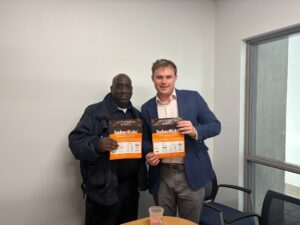
Image courtesy of Griffin Cappiello
By MaggieMae Dethlefsen
In a pivotal moment for civic dialogue, NewsNation brought Americans an event that goes against the grain of today’s media and political climate. We see an increase in polarization and heated rhetoric, which makes bipartisan dialogue very difficult. Chris Cuomo hosted a live broadcast aiming to tackle the most pressing and divisive issues facing the United States today in a bipartisan manner.
In an era when political dialogue is increasingly polarized and filtered through biased channels, the event offered a space where voices from across the political spectrum could be heard. Key topics of the night were immigration, crime, political violence, ICE, and the government shutdown.
When speaking on the government shutdown, Cuomo, Bill O’Reilly, and Stephen A. Smith welcomed Senator John Fetterman (D – PA) to help discuss the current state of the Senate on this topic, and how and when it will end. Fetterman is one of the few Democrats who has voted with Republicans in the Senate on the budget to keep the government running. “You don’t hold the government hostage,” Fetterman said. The panel discussed how you need the government to be open in order to be able to continue the debate, but also to keep funding flowing so that the American people are still getting the paychecks they need.
When the panel was fielding questions from the audience, an air traffic control agent, Jack, asked if this government shutdown would last longer than the previous Trump shutdown, which was the longest in history at 35 days.
Rep. Madeleine Dean (D – PA), Rep. Jim Jordan (R – OH), Rep. Ro Khanna (D – CA) sparred on stage about which party is truly to blame for the shutdown, trying to pass the blame off onto one another’s party Stephen A. Smith interjected “You’ve got people out here, an air traffic controller I know is doing DoorDash to make ends meet. What are we doing?” In disgust at the lack of consideration for the American people, Smith walked off the stage.
Former Senator and Governor of West Virginia Joe Manchin jumped in, saying, “If the greatest country on earth, the United States of America, can get Hamas and the Israelis in the same room [to] make a deal, we sure as heck can get the Democrats and Republicans in a room [to] make a deal.”
Health care policy also entered the debate, in regards to the impact it has had on the cause of this shutdown. Bill O’Reilly discussed Canada’s single-payer system as a model. This opened up the discussion for the typical divide on whether the U.S. should move toward universal health care or stick with a market-based approach. Smith again voiced frustration, implying that Congress has long punted on real reform while voters continue to face rising premiums and medical debt.
At the heart of that frustration was the ongoing government funding crisis and the looming threat of a shutdown. Smith’s condemnation of congressional inaction reflected wider public anxiety about federal dysfunction and its very real consequences for working families.
“We’ve got 33 trillion dollars in debt,” he added. “And nobody wants to take responsibility. Everybody wants to point fingers. That’s not leadership.” He clarified that his critique wasn’t personal to Rep. Dean, Rep. Jordan, or Rep. Khanna — it was aimed at Washington as a whole.
Immigration and national security were also major topics of discussion, driven by the presence of Tom Homan, White House border czar. The conversation centered on enforcement policies, asylum procedures, and whether the current system adequately balances security with humanity.
In addition, the panel discussed how ICE agents are allowed to wear face masks to conceal their identity, and whether the national guard is truly the most effective way to try and decrease crime here in the District or other cities. While Holman claimed that ICE is effective and is performing their orders effectively, many questioned whether the long-term effects truly were effective and are what is best for Americans.
The media itself was under scrutiny during the town hall. The panel was joined by Turning Point USA spokesperson Andrew Kolvet and political podcaster Adam Mockler, who talked about how the media can perpetuate and enhance the polarization we see in politics today. They also spoke on how social media is increasing political violence, because the algorithms we see will put us in these echo chambers of ideas.
During an opportunity for questions from the public, the president of American University’s College Republicans shared how this political polarization was most prevalent during a vigil held on the AU campus for Charlie Kirk after his assassination. Joe Manchin called for more accountability for what people put online, to be able to try and combat the problem of rising tension.
Though all the panelists of the night came from across the political spectrum, they all shared the sentiment that the tension in the political climate needs to be lowered for the best interest of the American people.