Msgr. James Shea Challenges Class of 2026 to Vanquish Mediocrity Through Friendship, Education, and Perserverance
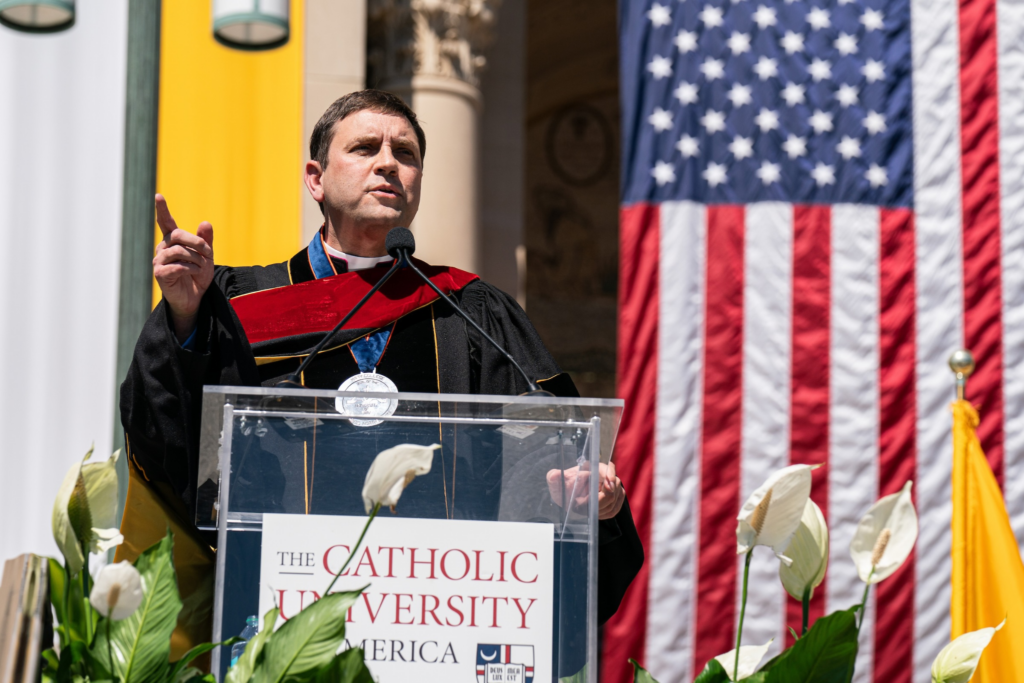
Image courtesy of The Catholic University of America.
By Griffin Cappiello
On the morning of Saturday, May 16, Monsignor James Shea, president of the University of Mary in Bismarck, N.D. and a priest of the Diocese of Bismarck, addressed the Class of 2026, their family and guests, and the faculty of The Catholic University of America as he delivered the 2026 University Commencement Address.
Msgr. Shea, who received a Bachelor of Philosophy and a Licentiate in Philosophy from Catholic University in 1997 and 1998, respectively, returned to his alma mater with great enthusiasm and pride.
“When I left here and went to Rome, my classmates at the Vatican’s North American College had a running joke that Jim Shea could not have a single conversation without mentioning The Catholic University of America,” Msgr. Shea remarked, “I couldn’t help it. I was so proud to be from here. I was so glad and happy to be from here.”
From the east steps of the Basilica of the National Shrine of the Immaculate Conception, Msgr. Shea shared a story of a trip he took with the health sciences faculty of the University of Mary to Dachau in Germany, one of the first concentration camps built by the Nazis. As they walked through what once held nearly 3,000 Catholic priests, Msgr. Shea explained, he and his faculty were told the story of the camp – how the priests were forced to build the crematoria of the camp, and how a French bishop who was held captive secretly ordained a seminarian who was dying of tuberculosis.
At the conclusion of their tour, their guide approached Msgr. Shea and shared that she was the translator of the last surviving priest of Dachau. At the end of his life, he told her that he felt grateful, yet ashamed of his life.
“‘I was a mediocre priest,’” he told her. “‘And it took Dachau to get the mediocrity out of my priesthood.’”
Msgr. Shea explained that he was haunted by this statement and that he, too, grapples with the very idea of mediocrity.
“The question of mediocrity, of human mediocrity, haunts every single examined life,” he said. “Something is not right about us. We are not as we should be, and we know it. This is what John Paul II called the gap between who we were made to be and who we are.”
He contended that talent alone is not enough to surpass mediocrity, suggesting that the most talented people can take hard work for granted. So too are wealth and honor, which only “amplif[y] our experience of mediocrity.”
What does contend with mediocrity, however, is “stability, constancy, perseverance, endurance, steadfastness, fidelity.”
“How did you get here today?” Msgr. Shea asked the graduates before him. “Yes, your minds were expanded and informed and transformed, but you’re here today also mostly because you kept showing up, because you didn’t run away, because you didn’t flake out.”
Similarly, he continued, friendship relies on this same endurance.
“Friends are there for each other through thick and thin…But to have and to harbor that kind of love requires a very demanding kind of trust, because in that, you open your very self to devastating heartbreak, pain, and betrayal,” Msgr. Shea explained.
“The only protection for us, the only place that we can go is to seek strength in numbers, to live joyful, meaningful lives of friendship with other ragamuffins and vagabonds here in this beautiful, broken world.”
In the same way, life with God demands endurance.
“The great tragedies in the epic Christian story are not about those who fail, but about those who throw in the towel, abandon their post, quit, and give up. But if we endure, if we persevere, if we don’t give up, then we always win,” Msgr. Shea proclaimed.
To stay constantly in communion with God and with one another is our charge, Msgr. Shea said, and to accomplish this, we must face each day head-on because “all that matters is right now.” We must avoid the regret of the past and the anxiety of the future and embrace the perfection of the present and the ever-presence of God.
“If we only have today, then what a day to have, what a day to begin!” Msgr. Shea concluded. Monsignor Shea received a Doctor of Theology honoris causa for his lifelong dedication to evangelizing society and commitment to the formation of young people.