CUA Cornerstone Program Honors First Graduating Class
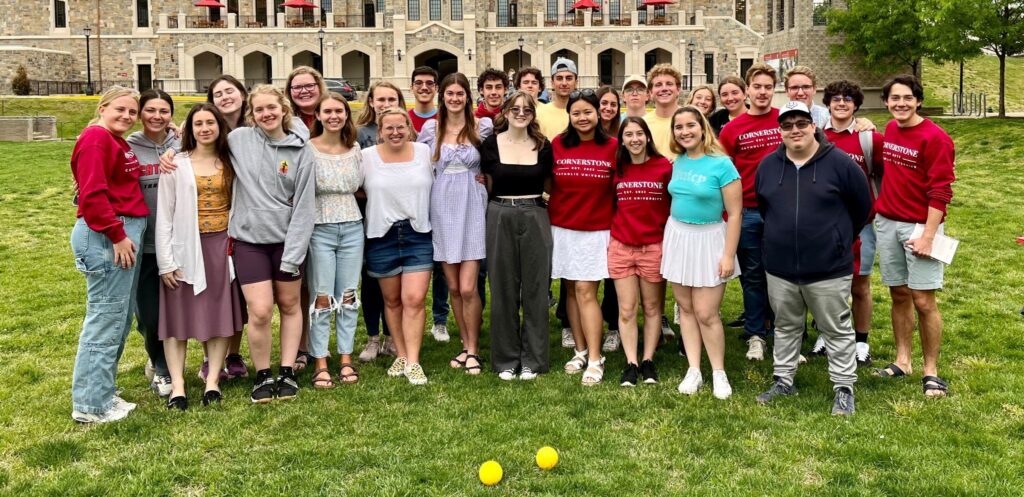
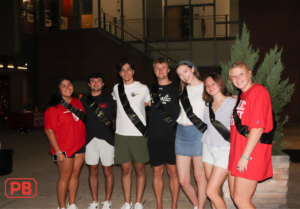
Image courtesy of the Cornerstone Program.
By Griffin Cappiello
This year, Catholic University’s Cornerstone Program, an interdisciplinary living and learning community designed to foster the growth of student-leaders and to promote the humanities, celebrates its fourth year at the University.
Cornerstone began at Catholic University in the 2022-2023 academic year after Dr. Thomas Smith, then-Dean of the School of Arts and Sciences, and Dr. Ernest Suarez, then-Chair of the Department of English, secured a grant from the Teagle Foundation and the National Endowment for the Humanities. The grant, which was created to promote the humanities and civic engagement on college campuses, fit in perfectly with Catholic University’s existing emphasis on the liberal arts.
Dr. Taryn Okuma, the Director of the Cornerstone Program and a Clinical Ordinary Professor in the English Department, was asked to direct the program, but she credits Dr. Seth Smith, Vice Dean and Associate Dean for Undergraduate Studies of the College of Arts and Sciences, with working to introduce Cornerstone to Catholic University.
“Dean Smith did a lot of legwork to make sure he met with all the deans on campus to make sure that the requirements would fit into different majors,” Dr. Okuma said. “The goal was to sort of offer this as a foundation for students and not get in the way of them actually finishing their majors.”
Students in the program are placed in the Learning Communities (LCs) exclusively with other Cornerstone students and take a series of gateway courses that fulfill the Foundations in Literature and Foundations in History requirements of the Liberal Arts Curriculum. They may elect to complete a Cornerstone Pathway, a selection of courses that fulfill additional Liberal Arts Curriculum requirements that has been curated to complement students’ majors.
“There are always people who are just going to be looking for a way to more fully integrate the humanities into their course of education,” senior musical theatre major Anthony Graf said. “Cornerstone offers a very practical solution to the problem of ‘I want to major in…biology or theatre or math, but at the same time, I want to get a liberal arts and humanities-based education, but I don’t really have the time to do a double major in philosophy or great books.”
Beyond the academic aspect of the Cornerstone experience, Dr. Okuma explained that the program truly came to life when the first cohort of Cornerstone students arrived on campus.
“For me, it has been an experience of really discovering what the program is through the students who are the Cornerstone Program,” she said. “You guys really are the program.”
Students also have the option to live in a community with their fellow students in the program; first-year students may opt to live in the Cornerstone wing of Regan and Ryan Halls. All of the events sponsored by Cornerstone on campus are student-driven, from organizing a weekly book club to cooking all the food for the annual Christmas party.
“Cornerstone really is just the perfect example of a community within a community,” senior elementary education major Caitlin Hernandez said. “I have so much gratitude for all the friends I’ve made and the faculty I’ve become close to through Cornerstone.”
Each semester, the Cornerstone Program hosts an excursion into the city to enjoy the arts; previous excursions have included visits to the opera, opportunities to watch musicals and Shakespeare productions, and trips to the symphony. Both Graf and Hernandez mentioned their trip to see Les Misérables at the Kennedy Center during their freshman year as a particularly memorable part of their Cornerstone experience.
“That was so awesome and so special, and I left just feeling overjoyed,” Graf said. “It was so cool to get that experience with my classmates and with people who were just as excited to experience it as I was. It was just a super fun outing.”
As the first class of Cornerstone students prepares for graduation, they expressed excitement for the future of the Cornerstone Program.
“It’s just really awesome to see that there’s more Cornerstone people coming in every year and sharing their talents and perspectives,” Hernandez said. “I only wish further continued success, and I am super confident that Cornerstone will continue to thrive over the years.”
“My hope is that we continue to attract students who want to get involved. I think some of that will involve maintaining these traditions that were established, but I think a lot of it is going to be finding a way towards new traditions,” Dr. Okuma said. “This is a program that is very dynamic in terms of the whole approach that the students take to their own sort of goals and career paths and experience in college, and I think the program has to reflect that…I just really hope that students continue to recognize that there are these opportunities for them to make the program awesome.”