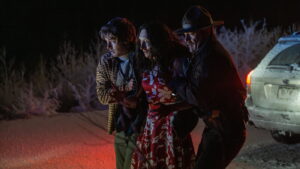
28 Years Later: The Bone Temple Offers Another Bloody Good Helping of Zombie Carnage

Image Courtesy of Sony Pictures
By Luis Zonenberg
After enjoying a nice helping of zombie mayhem thanks to Danny Boyle’s 28 Years Later, I was ready to try another course and figured I’d try out the film’s latest sequel, The Bone Temple. Both films were shot back-to-back in the summer of 2024, though interestingly chose to switch up directors with Nia DaCosta taking the helm for this entry. The film is performing poorly at the box office despite receiving immense acclaim from critics and audiences. I figured I would take a look and see if there’s a reason behind this odd phenomenon.
The story picks up right after the last one, with Spike (Alfie Williams) being rescued from a bunch of zombies by a satanic cult led by the charismatic Jimmy Crystal (Jack O’Connell). After partaking in a traumatic initiation ritual, Spike traverses with the cult, known as the “Jimmies,” to recruit more followers while getting rid of anyone who stands in their way. Spike soon befriends one of the members called Jimmy Ink (Erin Kellyman), with Ink looking out for Spike as the group slowly suspects them of straying from their religious ways.
Meanwhile, Dr. Ian Kelson (Ralph Fiennes) continues to oversee the Bone Temple he constructed, searching for the remains of dead zombies to help in his construction process. We slowly see him befriend one of the Alpha zombies named Samson (Chi Lewis-Parry), finding solace in his companionship after scouring alone for decades. His budding friendship with Samson sparks hope that he can create a cure that could treat the rage virus and stabilize the rest of the zombie horde.
The two separate stories feed into each other much better this time around, with the narrative feeling much more streamlined and not as choppy as its predecessor. The concept of a possible cure for the infected zombies is a gripping premise, beautifully complementing the budding friendship between Samson and Dr. Kelson. In execution, though, it unfortunately felt more like a side quest rather than the big event the marketing hyped up.
Even Spike felt more like an observer this time around, with Jimmy and Kelson getting the real spotlight this time around. Considering this served as a direct follow-up, it is baffling how they rarely acknowledge what happened in the previous film, despite it greatly shaping Spike’s character and his subsequent journey. This feels more like reading the middle of a novel, but thankfully, it remains fairly well-written and continues to expand the possibilities of what lies waiting in this world.
Even if the story is more underwhelming than its predecessor, DaCosta makes sure to keep the audience entertained with plenty of gore and scares to boot! While it’s not as sharp as Boyle’s direction, DaCosta knows how to keep the audience in suspense while delivering some beautifully-filmed zombie carnage. It was a tough act to follow, but DaCosta definitely proved herself this time around, delivering a visually striking sequel that expands the world while making sure to keep the audience glued to their seats.
The cast was highly entertaining to watch overall, with Alfie Williams turning in another great performance as Spike. Despite him being more of an observer this time around, Williams makes the most of his time on-screen and deftly captures the trauma his character endures throughout the film. Jack O’Connell proved once again to be a formidable foe, providing a demented but charismatic performance that was incredibly entertaining to watch. The real standout here was Chi Lewis-Parry as Samson, as he delivered an incredibly layered performance of someone rediscovering their humanity.
The makeup and overall VFX were just as good as its predecessor, making the zombies feel all the more feral and animalistic. The makeup especially helped make the zombies feel more authentic and believable, especially when it came to them chasing most of the main characters throughout the film. The costume design for the Jimmies was also quite unique and ironic, considering they were stylized after the late Jimmy Savile. Considering his dark past wasn’t unearthed until after his death, this choice makes the film all the more rich when you realize how they wouldn’t know about it in this world.
The cinematography felt much more grand and epic this time around, delivering plenty of sweeping landscape shots that really allow the audience to admire the lush scenery. The film looked cleaner and more refined than its predecessor, trying out its own style that ultimately works best during the more intimate moments and big spectacle-driven scenery. It was wise for DaCosta to develop her own style for this film, though at times it falls into the trap of trying to replicate Boyle’s more frenetic energy to better complement the other films in the series.
The film ultimately serves as a satisfying continuation of Boyle’s 28 Years Later, with the main narrative problem being how it feels more like the middle of a larger story. The film definitely leaves the door open for a sequel, teasing a number of possibilities that could take the franchise in a truly bold but exciting new direction. While it’s not as sharp or clever as the previous 28 Years Later, this pit stop at The Bone Temple showcases some brilliant direction from Nia DaCosta as well as a scene-stealing performance from Chi Lewis-Parry.
28 Years Later: The Bone Temple is now playing in theaters.
Rating: ★★★ ½ of five