Are We Living in a WWE Plotline?
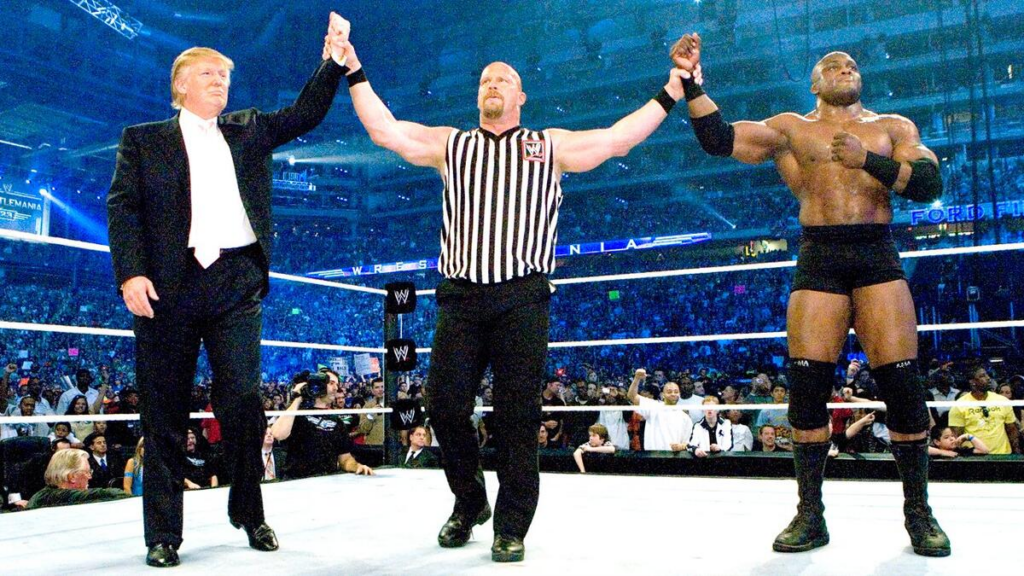
Image courtesy of photosWWE.
By Archibald Frey McNabb
This is an independently submitted op-ed and does not necessarily reflect the views of The Tower.
In a world where U.S. politics have devolved into the hurling of insults and self-loathing speeches, followed by chants and celebrity guests, maybe you feel like you’ve seen this somewhere. Maybe like something you’ve seen on Monday night. Maybe some of our president’s speeches remind you of a Macho Man promo. Do you ever see a politician slip out of character — even just for a moment? Quite often, politicians are performing, or playing characters. But that’s not to say they don’t reflect reality: they amplify it the way they want. President Donald Trump is a master of this dichotomy of performance and reality, which happens to be distinctly familiar and fundamental to the art of Pro Wrestling.
Just to get it out of the way, Pro Wrestling is fake. Or, to use the more sensitive and honest term, predetermined. Wrestlers are some of the toughest, most athletic people on the planet, but at the end of the day, they are putting on a show. Despite the predetermined nature of the shows, what they do is quite real, and that’s not only in reference to their high-flying stunts. Just like wrestlers play up the pain from hits, they also play up their real lives, their struggles, their relationships, and their feelings. Real-life events are woven into storylines, creating beautiful plots that are only possible because of their immersion in reality. They turn something that may be small, though still true, into a spectacle far exceeding its original circumstances. This unique blend of reality and fiction is why Pro Wrestling is so engaging. It is why Pro Wrestling has been—and remains—one of America’s favorite forms of entertainment.
At its core, Pro Wrestling is a battle between good and evil, often including The Babyface (good guy) vs. The Heel (bad guy). It is almost always true that the Babyface Wrestlers are favored by the majority of fans, but the line between Babyface and Heel has blurred over time. This is because fans want original storylines, and for Pro Wrestling to continue to sell tickets, the Heel can’t actually be all that hated. When fans truly hate The Heel, there is outrage when they win; when they lose, it begins to feel repetitive, and the threat of The Heel winning is lost. Wrestlers have learned how to toe the line and balance the boos just enough to get people on their side,to get the fans to sympathize with them and make them feel like they are siding with the uncensored, misunderstood hero who fights for the truth in a world of lies. Does that sound familiar?
Did you know that our president is in the WWE Hall of Fame? Trump appeared in the WWE as an on-and-off celebrity character, most notably in the “Battle of the Billionaires,” a feud between himself and WWE CEO Vince McMahon, which ended in Trump shaving Vince’s head live in the ring. Trump was a performer long before his political career, and his time in the WWE reflects his political technique. Trump is a Heel; he understands how to be hated, and he knows how to take that hate and turn it into support. Although the people are booing, they are still making noise for him. That noise is needed to remain in character, both to himself and his supporters. Trump supporters do not ignore Trump’s provocative nature because of their support for him or his policies; they support him because of it.
Politicians have struggled to keep the masses of America engaged. So why not take techniques directly from one of America’s most engaging forms of entertainment to scratch the same itch? Trump knows how to keep people engaged, especially people who — if not for Trump’s character — would not be involved in politics at all. So next time you hear a speech from Trump, close your eyes and picture a wrestler. Juiced up on steroids, with a similar spray tan to what Trump already has, in a neon singlet, and just think: “Which parts of this are for the show?”

Image courtesy of The U.S. Sun.