Panel Shares Realities of Homelessness in D.C.
Image courtesy of Cristina Sandoval.
By Millie Bamsey
This week, Catholic University students, faculty, and staff are participating in Hunger and Homelessness Awareness Week events on campus alongside organizations across the country. Since 1975, beginning at Villanova University, volunteers at universities, churches, schools, and organizations have gathered their local communities the week prior to Thanksgiving for advocacy, prayer, service, and education to end hunger and homelessness. Groups across CUA have collaborated with the Charitable Services arm of the Office of Campus Ministry to organize events to shed light on and combat these critical issues.
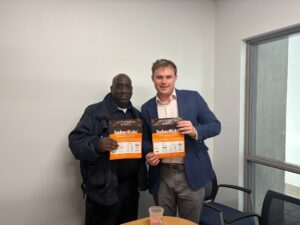
On the evening of “Testimonial Tuesday,” the Pryz Great Room doors opened for a panel lecture titled “From Displacement to Dignity: Supporting Unhoused Residents in DC” featuring CUA’s own Meg Hannigan Dominguez of the National Catholic School of Social Service as moderator. The panel consisted of Wesley Thomas, formerly unhoused in D.C. himself and now a mentor of homeless addicts through Miriam’s Kitchen; Amanda S. Chesney, Executive Director of Homeless and Housing Services at Catholic Charities of the Archdiocese of Washington; Shannon Clark, a member of the advocacy team at Miriam’s Kitchen; and Benn May, a second-year Master’s in Social Work student at CUA.
The panelists spoke about their personal paths to working to combat homelessness, as well as sharing advice about how to get involved in the efforts and commenting on recent actions by the Trump Administration that have impacted the homeless population in D.C.—notably, ICE raids, the government shutdown, and, primarily, the executive order placed on July 24 of this year vacating homeless encampments from the streets of D.C.
They shared how the executive order in particular affected the operations and services of their own organizations. Chesney said that Catholic Charities had to make space for 95 new beds across their 5 D.C. shelters with no notice.
May boldly remarked, “[The actions of the executive order] do nothing for anyone involved—for the unhoused folks, us, the city—it just gives the impression that we’re “cleaning up,” but we’re erasing people.”
Clark said that between the executive order declaring it illegal to sleep on the streets and the presence of ICE in the city, clients of Miriam’s Kitchen who were in the process of getting housing or substance abuse counseling can no longer be found where they normally reside, as they have begun to ride the bus at night or have migrated to Maryland or Virginia out of fear.
During the Q&A portion of the evening, Vincent Wills, a sophomore and student leader of the Homeless Food Runs service site within Campus Ministry alongside Aiden Shannen, shared with the panelists that Homeless Food Runs’ normal service destination of Union Station had been empty over the past few weeks, mentioning the National Guard as a driving factor. He asked panelists if they knew any more populated places around D.C. where their services would be better received. Clark replied with a few recommendations, but noted that she and others had been advised not to “broadcast” those locations because unhoused individuals would rather be hidden during a time where they could face such consequences for being homeless.
When asked what they wished people understood about unhoused people, the panelists shared a variety of responses:
May: “Homelessness is not a moral issue. A homeless person is not homeless because of a moral failure…we are all a lot closer to being homeless than we realize.”
Thomas: “Homelessness has no ethnicity and no singular financial profile.”
Chesney: “Getting involved is everyone’s responsibility. Talk to your council members and representatives. Use your gifts and passions to help other folks.”
Clark: “We all live in a society where homelessness exists. It’s on all of us to connect with the homeless in our communities and allocate some of the wealth in this country toward helping them.”
Educational resources were offered from the National Alliance to End Homelessness and The Way Home Campaign about how to advocate for more city funding for homeless shelters. Charitable Services volunteers also distributed and collected homeless service advocacy postcards addressed to Matthew Frumin, Ward 3 member of the Council of the District of Columbia. Advocacy letter-writing continued Thursday morning and afternoon with Campus Ministry’s postcard campaign in the Pryz.
May shared an insight from his Jewish faith that he said has shaped his own view of his participation in the mission to end homelessness: “If not us, who? If not now, when?”