Pope Francis Passes Away at 88

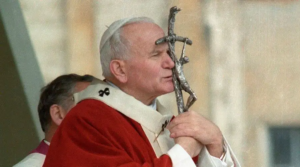
Image Courtesy of the Basilica of the National Shrine of the Immaculate Conception
By Zachary Lichter
As Catholics around the world celebrated Easter with joy and happiness, things took an emotional turn on Monday, April 21 when people woke up to the news that Pope Francis passed away from heart failure and a stroke. He died in the Vatican at 7:35 a.m. local time. The news of the Holy Father’s passing broke out at 6 a.m. Eastern Standard Time in the U.S. as channels like CBS, NBC, and the ABC had special reports, an hour before their regularly scheduled newscasts.
The Holy Father’s passing comes after spending a month in Gemelli Polyclinic Hospital in Rome when he experienced difficulty breathing. The doctors treated him for bronchitis, but he contracted pneumonia in both of his lungs. He was put on a ventilator until the doctors reported he was “stable.” From then on, he did physical therapy until he got discharged on March 23.
Pope Francis was born with the baptismal name, Jorge Mario Bergoglio on December 17, 1936 in Buenos Aires, Argentina. He was called to the Jesuit order in 1958 and was ordained a priest on December 13, 1969 as Father Jorge. From 1973 to 1979, Father Jorge became the head of the Jesuit province of Argentina.
In 1992, Pope John Paul II appointed him as an auxiliary bishop of the Archdiocese of Buenos Aires and was ordained on May 27, 1992 as Bishop Bergoglio. He then became the Archbishop of the Archdiocese of Buenos Aires in 1998. Then in 2001, Pope John Paul II promoted him to be a Cardinal and he still continued to serve the Archdiocese of Buenos Aires until he was elected to the Papacy in February 2013.
When the late Pope Emeritus Benedict XVI resigned in February 2013, Cardinal Bergoglio was elected to the Papacy at the age of 76 during the fifth ballot of the Conclave. Cardinal Bergoglio chose the name Francis after St. Francis of Assisi because he was inspired by his simplicity and service to the poor. He also chose the name Francis because of St. Francis Xavier, who was the founding member of the Jesuits. Pope Francis became the first pope to be named Francis along with being the first pope from the Western Hemisphere and from the Jesuit order.
During Pope Francis’s papacy, the Holy Father was simplistic by staying in the Vatican hotel instead of the Apostolic Palace. Instead of riding in the papal limousine, he rode in a compact car or took the bus. He even visited the poor, sick, and those imprisoned.
He reached out to people in all walks of life whether they were from a different Christian denomination, religion, or sexual orientation. In 2016, he allowed women to get their feet washed on Holy Thursday. He also washed the feet of prisoners and Muslims. His acts of ministering to others outside the Church would earn him the title of “The People’s Pope.”
In 2015, Pope Francis visited the U.S. where he canonized Junipero Serra, a saint known for his evangelization and colonization of California at the Basilica of the National Shrine of the Immaculate Conception. This was the first time a saint was canonized on U.S. soil. While he was in the U.S. he became the first pope to address congress.
In addition to visiting the U.S., in 2019 the Holy Father was the first pope to visit the Arabian Peninsula. He went to Abu Dhabi to promote peace and religious fraternity. He even celebrated a Papal Mass where an estimated 180,000 people attended.
When the news broke out of Pope Francis’s death on April 21, President Peter Kilpatrick, the President of Catholic University of America (CUA) informed the CUA community of the Holy Father’s passing and invited everyone to the Rosary Vigil at the St. Vincent De Paul Chapel at 9:30 p.m. Campus Ministry also had a Requiem Mass on April 28 at 5:10 p.m at the St. Vincent De Paul Chapel.
Father Bernard Knapke, the Chaplain for Worship commented on why Pope Francis is called “The People’s Pope” and how people should remember him.
“It’s the fact that he really made an effort to stay physically close to the people of God,” Father Bernard said. “It’s the iconic photo of him taking the Metro as a priest in Buenos Aires.One thing to reach out and be in the crowd even as pope in St. Peter’s he imitated St. John Paul II very much in this way and it’s something he emphasized in his writings was that pastors need to be close to the sheep and I think he did that in an iconic and symbolic way just in how he carried himself throughout his pontificate.”
Father Aquinas Guilbeau, the University Chaplain and Vice President of Ministry and Mission commented how Pope Francis has influenced his life.
“After benefiting from the doctrinal clarity of John Paul II, and the spiritual depth of Benedict XVI, I have been reminded by Pope Francis that the Church’s doctrinal clarity and spiritual depth are meant for all people, especially the marginalized and forgotten,” Father Aquinas said. “Every pastor must have as a priory of mercy making the supernatural treasures of the Church accessible to all.”