
Should We Really Celebrate Columbus?
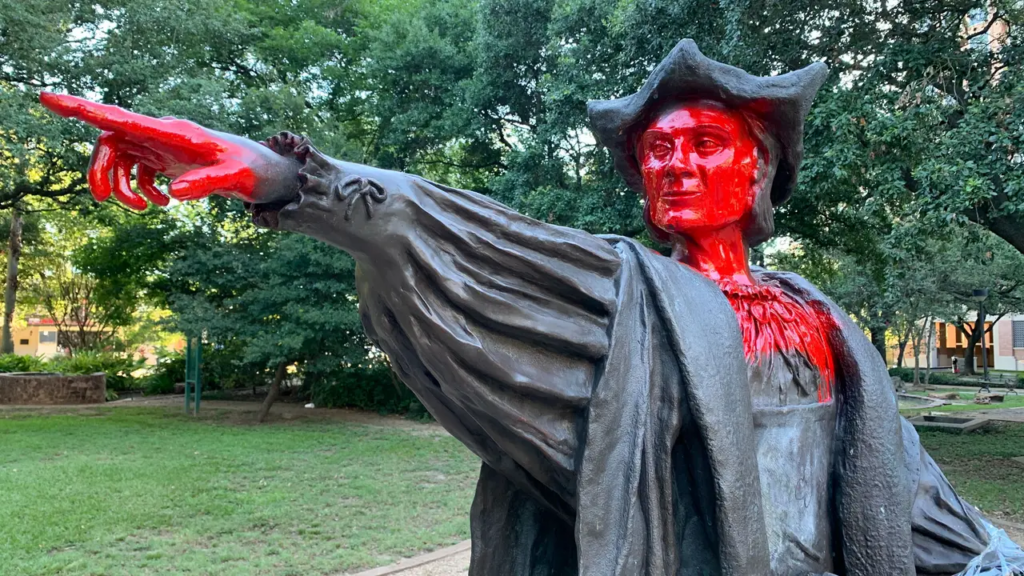
Image courtesy of Fox26Houston.
By Archibald Frey McNabb
This is an independently submitted op-ed and does not necessarily reflect the views of The Tower.
The second Monday of October has passed us by, marking the celebration of Indigenous Peoples’ Day and Columbus Day. These coexisting celebrations reflect the sad reality of Columbus’s history.
Yet among both Americans and Catholics, a reverence for the figure of Christopher Columbus remains strong.
Catholics have played an integral role in upholding Christopher Columbus’s reputation and, unfortunately, have overlooked this upholding’s deleterious nature. This selective view of his actions neglects the life he actually lived and does not give proper care to those who felt and continue to feel the effects of his actions and colonialism as a whole.
Columbus Day was first established as a federal holiday by President Franklin D. Roosevelt in 1937, due in major part to the lobbying of the Catholic fraternity, the Knights of Columbus. At this time, both Italian and Catholic discrimination were widespread across the United States, and Columbus could be used to highlight both their roles in American history.
The promulgation of him as an American symbol eventually distorted our understanding of his true involvement in the forming of our country, and although he served as a needed symbol for the importance of immigrants, this distortion created an untrue image and neglected why exactly he might not be praiseworthy.
Columbus first landed on the Bahamian island of Guanahani, which initiated European colonization, leading to the eventual colonization of the land now known as the United States. However, for the rest of Columbus’s life and voyages through South America, he insisted that the land he had reached was the outskirts of Asia. He asserted this belief in a letter to Pope Alexander VI requesting missionaries to be sent to evangelize the native people. That request was not directly implemented; however, Pope Alexander VI did mandate that Spain “Christianize” the land.
Like many events at the time, this Christianization of the land was not done peacefully. It was carried out through violent conquest, exploitation, and forced belief.
But Columbus was not just a bystander in this harmful mob.
In 1500, a time when colonists were not expected to treat indigenous people with care, while serving as governor of Hispaniola, Columbus was arrested and sent back to Spain because of his harsh treatment of both Indigenous people and Spanish settlers. Upon arrival back in Spain, he was freed but lost his position as governor. Columbus was condemned in his own time for his actions, so why does a defense of his character remain?
Focusing on only the positive aspects of Columbus is a rejection of the person he truly was. Columbus portrayed as an admirable person is a ridiculous caricature that only exists in a world that neglects the serious consequences of imperialism. While we shine light on him, we dim the light on the effects of his actions. We lose the needed sympathy for the people who lost their homes, cultures, and lives due to his actions. While Columbus has served as a symbol of hope and discovery for white Catholics, He more accurately embodies the pain and loss of colonialism for indigenous people.
There is a deep history close to both Americans and Catholics of celebrating Columbus, which is real and worth commemorating, but it needs to be done properly alongside justified criticism. The weight of Columbus’s character is real and therefore is not something that can or should vanish. It is possible to still acknowledge the character of Columbus; what is needed in the commemoration is deep consideration of his actions and their implication for all Americans, not just those he represented.