Saint of the Week: St. Vincent De Paul
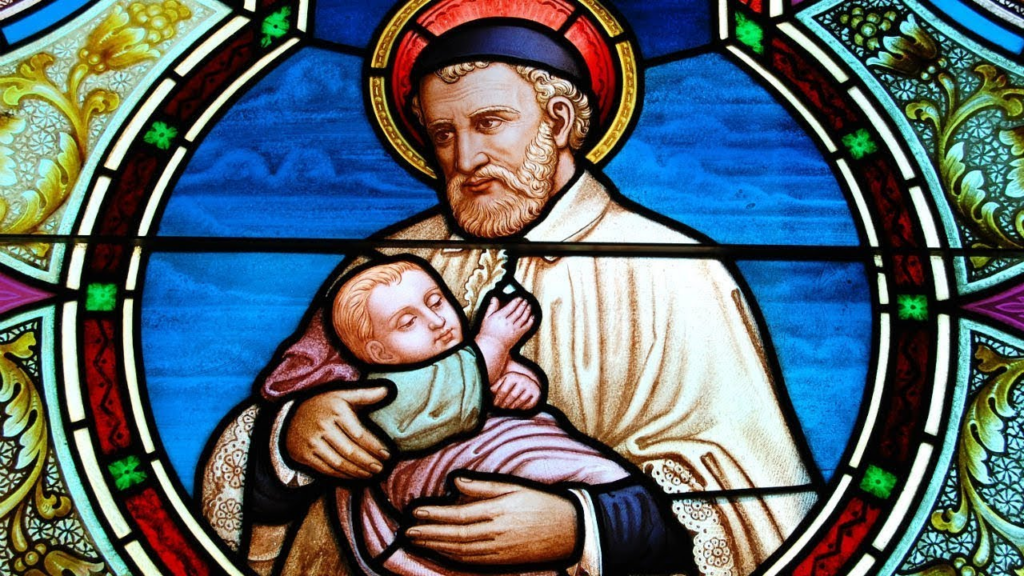
Image courtesy of Catholic Online.
By Paul Manetto
Now, maybe, before you walk into a church, you make it a point to read everything about the saint it is named after, diligently reading an 800-page biography of their life and cross-referencing it with research deep in the annals of the Catholic Church’s archive. If you’re that type of person, I say more power to you! But more likely, you’re like me, and don’t give the name of the church much thought, and give more attention to the design, music, and how long the homily is going to be. But understanding who the people are that communities choose to name houses of worship after is a great way to see more closely the life of a holy man or woman who, despite life’s struggles, made it home to heaven with God. And with that long-winded intro, it is with great pleasure that I announce this week’s saint to be Vincent De Paul, patron of our university’s largest chapel.
Vincent De Paul was born in Pouy, France (hence the “de” in his name) in 1581. His family were poor peasants, and he spent much of his early life doing poor peasant things, like walking miles to graze cattle with no shoes on. His family did manage to scrape together enough money to send him to be educated by the Franciscans, and he did so well that a wealthy family hired him as a tutor, allowing him to save enough money to attend the University of Toulouse. He was ordained a priest in 1600.
Like many saints, he had a thrilling near-death adventure in his early life, taking the form of being enslaved to the Turks for two years, until he escaped back to France in 1607.
His life took a major turn when he became the chaplain to the Count of Goigny (in those days, wealthy people bought their own personal priest; life must have been good for old Count Goigny). It was here he discovered a love of charity work and evangelization, which would define his ministry and his legacy. He soon left Giogny and focused all his energy on serving the poor across Europe. Inspired by the ld motto “If you want something done right, do it yourself,” he founded two entirely new religious orders: the Ladies of Charity for lay women and the Congregation of Priests of the Mission, which, in case you couldn’t tell, was for priests. This group of priests would go on to operate 53 seminaries and offer retreats to help build a better foundation for the Church’s priests.
One other aspect of Vincent’s ministry was helping those imprisoned. He was appointed by the King of France as prison minister, or in a much fancier way of saying it, the “Chaplain of the Galleys.” Today, Vincent is remembered as the patron saint of charities, hospitals, philanthropists, and prisoners. Perhaps you want to follow in Saint Vincent’s footsteps; participating in one of Catholic University’s many service activities is a great way to do that. Or maybe just say a quick prayer to him the next time you stop by St. Vinny’s.