A Crash Course in Fulton Sheen
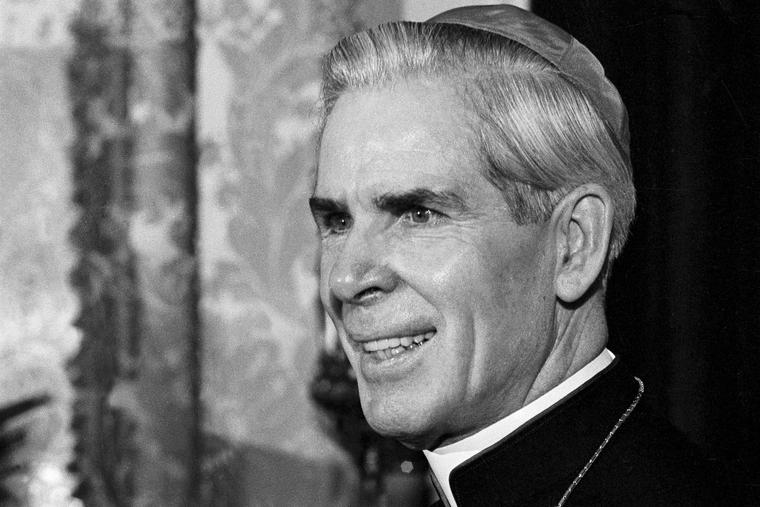
Image courtesy of National Catholic Register.
By Paul Manetto
With a school that counts governors, senators, and even cardinals among its many alumni, The Catholic University of America added a new honor to that list on Sept. 24, 2026. This honor is beatification, one step away from sainthood. However, this recent thrust into the spotlight has left many students wondering: who was Bishop Fulton J. Sheen, and what about him makes him worthy of sainthood?
Born in El Paso, Illinois, on May 8, 1895, Sheen was christened Peter John at birth, but would be known his whole life by his mother’s maiden name, Fulton. His formative years were spent in Peoria, Illinois, where he lived out his family’s devout Catholic faith as an altar server. Soon after graduating high school, Sheen left Peoria for St. Paul Seminary in St. Paul, Minnesota, where he would study for the priesthood before being ordained in his home Diocese of Peoria in 1919.
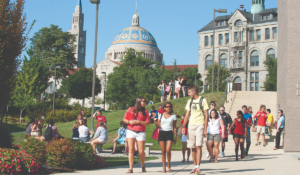
It was in the years after his ordination that Sheen first studied at Catholic University, before leaving to finish his doctorate overseas in Belgium. Upon becoming a professor, Sheen taught at St. Edward’s College in Ware, England, before returning to Catholic University in 1928, where he would spend the next twenty-two years. During this time, Sheen authored 34 books, researched in the Mullen Library (opened in 1928), and lectured in McMahon Hall, where a popular story is that students would sit on radiators to hear him speak.
Sheen’s time at Catholic University came to an end in 1951 when Pope Pius XII promoted Sheen to an auxiliary Bishop in the Diocese of New York. In 1966, Pope Paul VI named him Bishop of Rochester, where he would serve until he became archbishop of Newport, Wales, a ceremonial role allowing him to focus entirely on his evangelization efforts. As the chaos of the 60s raged across the country, Sheen drew criticism for his opposition to the Vietnam War and his transfer of an empty parish to be used as housing for African Americans.
However, while a distinguished scholar and bishop, what gave Sheen recognition was his use of mass media to promote the Catholic faith in a country long sceptical of the Church and papal authority. First going on air in the 1930s with a weekly NBC radio show, Sheen began his television show, Life is Worth Living, in 1952 on the Dumont Television Network. Unpaid and up against rival slots such as The Frank Sinatra Show on CBS, Life is Worth Living became an unabashed success. Educating an often ignorant public on the intricacies of Catholicism, Life is Worth Living ended its run having appeared on 15 networks, with up to 30 million people tuning in each week, and Sheen taking away three Emmy Awards by 1957. Sheen was praised for his explanations not just of the Catholic faith but of key socio-economic concerns of the time.
With Life is Worth Living ending its run in 1957, Sheen continued his life of learning, writing 32 more books and recording his lectures for the next generation of priests. Sheen died on Dec. 2, 1979, having lived a life that changed the way Catholicism was viewed in the United States.
Made Servant of God in 2012, by Church tradition, Sheen had to have at least one miracle to be beatified. In 2019, the Vatican recognized the healing of a stillborn infant as that miracle, and after a delay for additional investigation, Sheen canonization was announced for September of 2026. The community of Catholic University should take pride and celebrate the amazing witness and beatification of fellow Cardinal and now Blessed Fulton J. Sheen.