Spookapella Brings Together Washington Area A Capella Groups
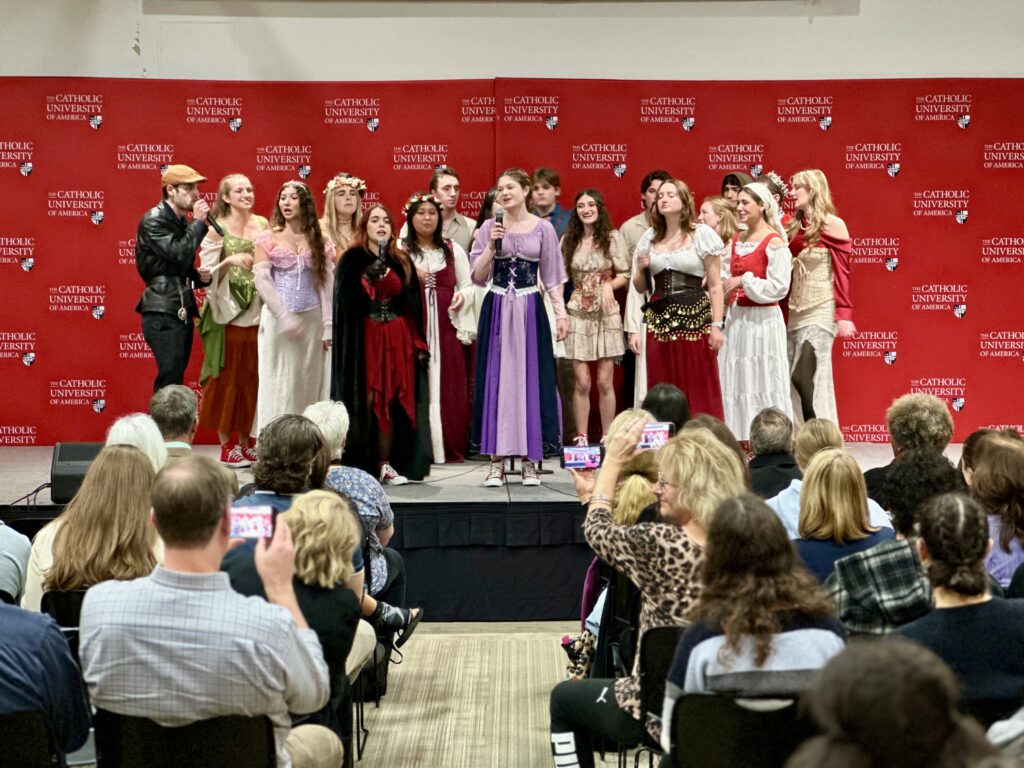
Image Courtesy of Luis Zonenberg
By Alexandra Berrick
The eleventh annual Spookapella took place at Catholic University on Friday, November 6. Hosted by Redline A Capella, the event brought together a capella groups from Catholic University and other colleges in the Washington metropolitan region for a night of performances.
Groups came from Georgetown University; George Mason University; American University; University of Maryland, College Park; and University of Maryland, Baltimore County. Each group came in costume, with themes ranging from “Renaissance Fair” by Redline, to “Clowns” by Take Note and “Barbies and Kens” by Washingtones.
The hundreds of attendees were able to enjoy donuts and cider as they listened to songs from a wide range of decades and genres, from “Sh-boom” by The Chords to “Midnight Sun” by Zara Larsson to The Washingtones’ rendition of “Viva la Vida” by Coldplay.
Spookapella is a rare opportunity for students from different colleges to come together and celebrate their talents rather than compete with one another.
“As someone who doesn’t really sing, too, it’s like ‘Wow, they’re really good at what they do,’” freshman environmental engineering major Malia Thole said.
The crowd was fully engaged, clapping along to the beat and filling the room with their cheers. Particularly notable were the members of Take Note A Capella, who, during Redline’s final song, “Light On” by Maggie Rogers, rhythmically swayed back and forth in a show of support. Once the show ended, members of Take Note started to repeatedly chant, “Redline.”
A capella is an uplifting experience not only for audience members but also performers.
“You’re creating something with someone, but you actively get to see what you create in real time,” junior psychology and social work double major Tammy Pattugalan, a member of Redline, said.
A capella is a one-of-a-kind art form. It takes familiar songs, often popular songs that are proven to unify people, and puts a unique spin on them. The sound created is one that cannot be replicated by any other assembly of people. Above all, this is done with no instruments save for the human voice. It is a testament to what the body can create, and its power to connect people through sound.
“Music is a universal language. In a cappella, I think, is music in one of its truest forms. It’s just a collection of human voices coming together to create, like, a beautiful sound,” sophomore psychology major Lorenzo Maione, Redline’s secretary, said.