Catholic University and AU Students Combine for Kingship of Christ Lecture
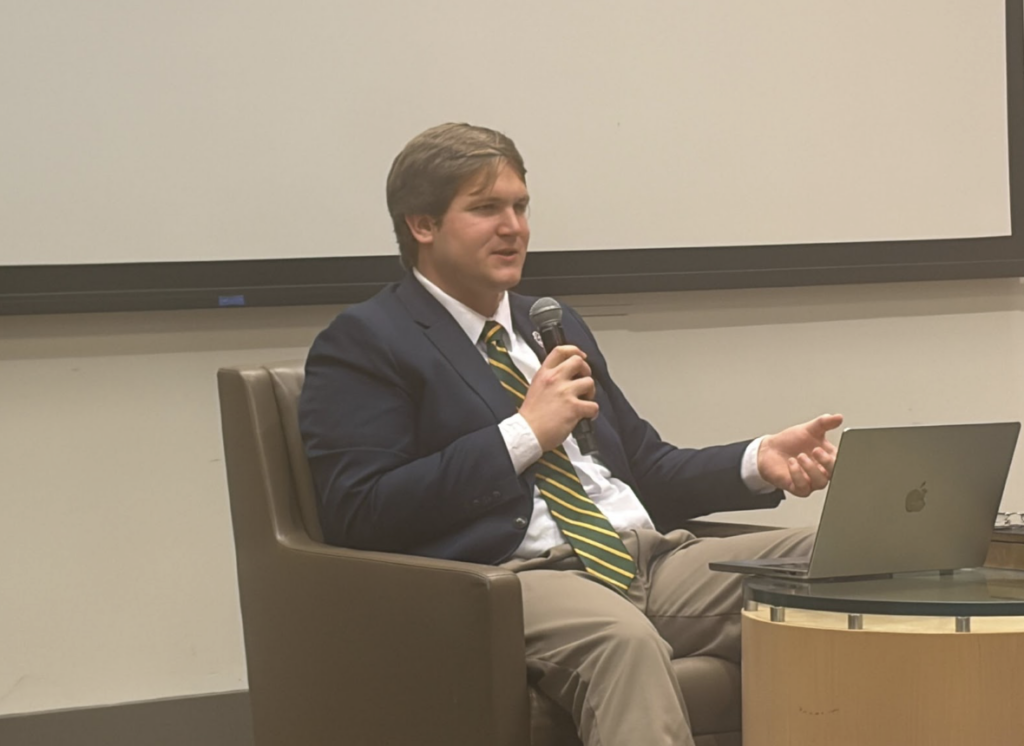
Christian B. Wagner addresses an audience question.
Image Courtesy of Anthony Curioso
By Anthony Curioso
On a bright, sunny Saturday evening, a group of curious students from The Catholic University of America (CUA) and American University (AU) gathered in Great Room A at CUA’s Pryzbyla Center for a lecture on the social kingship of Jesus Christ.
The lecture took the form of a short seminar-style presentation and a longer Q&A session, organized in part by the CUA chapter of the St. Robert Bellarmine Society, with the group’s founder, Jack Hermes, a junior business major and the Student Body President-elect, representing the group and serving as emcee for the event. Other event co-sponsors included the AU chapter of the College Republicans and The Thebaid Publication.
The presenter was Christian B. Wagner, a Catholic theologian best known for his work on the Scholastic Answers YouTube channel and the Apologia Anglicana blog, which appears to be an offshoot of the channel.
Wagner began his individual portion of the lecture by sharing that it seemed quite topical, given the recent news of conflict between the Holy Father, Pope Leo XIV, and U.S. President Donald Trump over the latter’s handling of the war in Iran.
Wagner argued that the concept of the social kingship of Jesus is to be understood as a “domination” of Jesus Christ as King over the secular kings of the world, citing God’s plan to subdue the world and to guide all the world to follow Him. After the Fall, Wagner explained, God promised that a future Redeemer, that is, Jesus Christ, would come to save the world and finish the work that Adam and Eve could not. Additionally, Wagner shared that similar messages about a forthcoming Redeemer are repeated throughout much of the Old Testament and in several Psalms; however, many Protestants misinterpret these passages in a collectivist manner.
The ultimate goal, as Wagner sees it, is to convert as many people and social groups to the Catholic faith as possible. He also points to the sections of the Catechism of the Catholic Church on religious liberty, arguing that God should be honored both publicly and privately.
“The King is meant to wield the temporal sword through the hands of priests,” Wagner concluded.
Following his talk, Wagner took questions from the audience. In response to a question about societies, Wagner argued that Catholics are members of secular society in that they live in a certain place, and they are also members of the society that is the Catholic Church; these societies are distinct for a reason, and he believes they should remain so.
Wagner also took a question on how to respond to concerns of the spreading influence of Communism and Islamist terrorism in the U.S.; however, he dissuaded attendees from the notion that these would be an overwhelming issue here, as the United States had already spearheaded what he described as a successful triumph of Western liberalism over Eastern Communist ideals in this country.
“Is there going to be revolution, infiltration, or submission? Those are the main options,” Wagner said, on the conflict between Israel and Iran and the struggle between Islamism, American ideals, and overall Western liberalism. “As the two other options are not realistic, the only option left is to follow the path of the Israelis, which is infiltration.”
Another question from an audience member centered around how to make it far in politics while also maintaining good standing as a Catholic. Wagner responded that there were two things that someone striving toward this goal should have: an expansive network and a strong devotion to the Sacred Heart of Jesus.
Wagner recommended that newcomers to his digital content start by searching Google for his name alongside a specific Catholic topic they are interested in learning more about, then viewing his relevant blog post or YouTube video.