CUA Celebrates Eleventh Annual Research Day
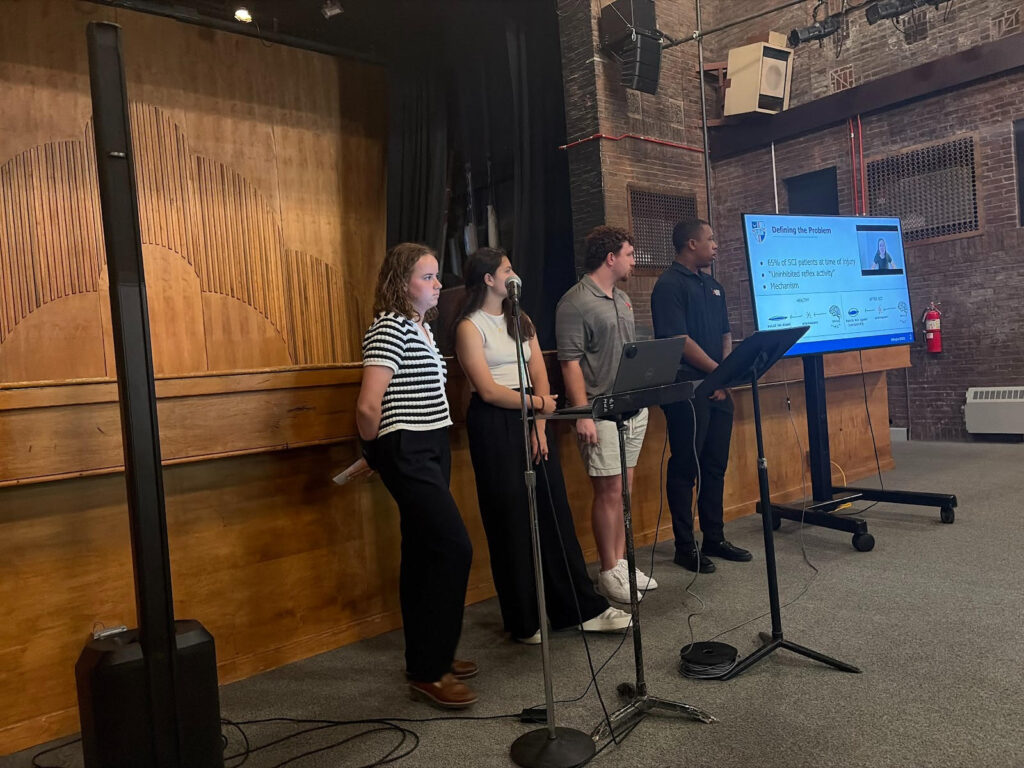
Image Courtesy of Anthony Curioso
By Anthony Curioso
In keeping with its “R1” status as one of the top research universities in the United States, CUA hosted its annual Research Day on April 15.
All classes were canceled so that students, faculty, and staff from across the university could gather to hear a keynote address and see their peers and colleagues present research projects they had been working on over the past year.
As Research Day approached, there was some controversy and confusion among students regarding a new requirement for this year’s event: that all students must attend at least one portion of it. This misunderstanding likely arose because students received official notification of the attendance requirement only one day before the event, via an email from the Office of the Provost. However, those who checked the Research Day website in recent weeks would have seen that this requirement was listed there as well. The University recorded student attendance by having students fill out a raffle entry form with their name and a four-digit “program event ID”; this raffle included prizes such as CUA merchandise, an iPad, and gift cards.
The day began in the Della Ratta Auditorium in Maloney Hall, where opening remarks were made by Dr. Reiko Asano, co-chair of the Research Day planning committee and clinical assistant professor in the Conway School of Nursing, along with University President Peter Kilpatrick, Provost Aaron Dominguez, and Joseph Yost, the senior vice president for research.
Provost Dominguez shared that Research Day is one of his favorite days of the academic year because it allows the entire University community to witness the diverse range of research conducted by their peers. He explained that the event was conceived by himself and the late Ralph Albano, who served as Vice Provost for Sponsored Research, Research Compliance, and Technology Transfer at CUA until his death this past June.
The keynote address, delivered by CUA sociology professor Brandon Vaidyanathan, was entitled “Beauty of Understanding.” Vaidyanathan explained that a sense of delight drives people in their moments of discovery, and the overarching thread of “the beauty of understanding” is the significant driving factor behind his current research. Vaidyanathan mentioned that the philosophical writings and research of Michael Gorman, a current Ordinary Professor and the holder of the Father Kurt Pritzl, O.P. Chair in Philosophy at CUA, significantly inspired him. Gorman was also a former professor at Vaidyanathan’s undergraduate alma mater.
After the keynote address, the University community dispersed at around 10:30 a.m. Some attendees stayed in the Della Ratta Auditorium, while others moved to five additional auditoriums around campus for a series of “oral presentations,” which consisted of ten 10-minute PowerPoints followed by a 2-minute Q&A session for each presenter, time permitting.
Several intriguing oral presentations took place in Ward Recital Hall during the morning session. Among these, a group of junior biomedical engineering majors, led by Clare Tong, presented on their junior design project that aimed to alleviate spasticity, or muscle weakness and stiffness, in the upper arms of patients who had suffered spinal cord injuries.
The other notable oral presentation in Ward Recital Hall was conducted by a group of students led by junior psychology major Raquel Ruiz. This group analyzed the perspectives of CUA community members, based on a survey, regarding the ethical use of artificial intelligence (AI) in higher education.
After lunch, CUA community members had a more casual opportunity to present their research projects to peers and colleagues during a poster session that began at 2 p.m. in the Pryz Great Rooms. Notably, the editorial staff of The Tower was well represented among the presenters at this poster session.
One intriguing poster was presented by sophomore media major Griffin Cappiello, who is the outgoing sports editor and current editor-in-chief-elect of The Tower. Cappiello’s poster connected his academic interests with the role he is about to vacate at The Tower, as he analyzed the significance of writing in society through the lens of sports journalism.
Along the same row, another poster that drew significant interest was presented by Anthony Curioso, a senior music education major and the outgoing SGA correspondent for The Tower. Curioso’s poster analyzed three different complete editions of Mozart’s incomplete Grand Mass in C Minor, K.427/417a, to determine the most appropriate edition to use in a liturgical or performance context.
At the end of Research Day, the CUA community gathered in Heritage Hall at 4 p.m. to find out the winners of the attendance raffle, the recipients of awards given to the best essay from the freshman Learning Community (LC) classes, as well as the awards recognizing the best oral and poster presentations from each of four categories: undergraduate students, master’s degree students, doctoral students, and faculty members.
The recognition for the best LC class essay went to freshman Josefina Prosperi, for a research paper she had written in the English 101 LC course.
The award recipients for the best oral presentations included Mary Rose Yockel (a doctoral psychology student who presented “The Impact of Parenting Self-Efficacy on Child Involvement in Illness Management and Functioning in Families where a Child has a Medical Condition”) and Haley Jackson (an architecture master’s degree student who presented on the preservation efforts and reimagining the purpose of the J. Edgar Hoover Building). Tong’s presentation was also recognized, as the best oral presentation given by undergraduate student(s).
As for posters, DNP student Amanda Svetz’s poster on the implementation and documentation of skin-to-skin contact for babies in the NICU was judged the best presentation by a doctoral student; master’s student Trinity Johnson won recognition for the best poster by a master’s degree student for her poster on the genealogy of charisma and its role in the collapse of failed democracies; and a group of senior undergraduate civil and environmental engineering majors, led by William Granci, won the recognition for best undergraduate poster with their work on this year’s edition of the College of Engineering, Physics, and Computing’s annual steel-bridge design competition.
Faculty award recipients for excellence in teaching included Glenn Østen Anderson (media and communications), Dr. Dominick Rizk (computer science), Dr. Nicholas Comeau (nursing), Dr. Keren Dali (library and information sciences), Dr. Taryn Okuma (English), and Dr. Michael Promisel (politics).