Catholic University Professors Hold “Teach-in” in Opposition to War in Iran
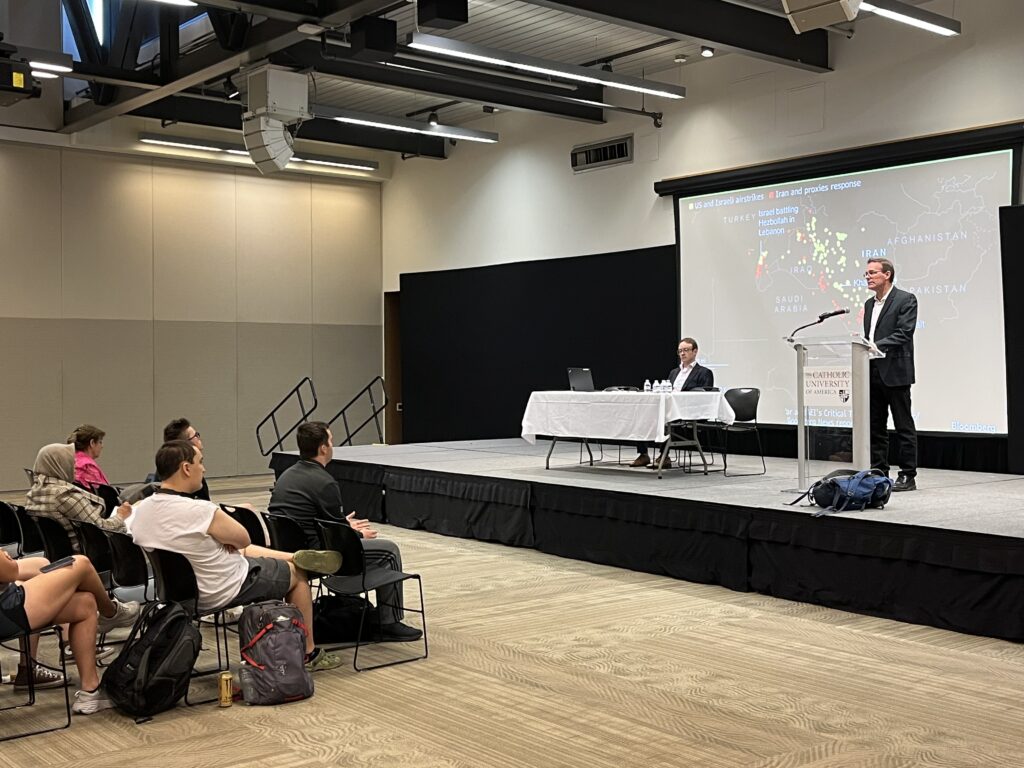
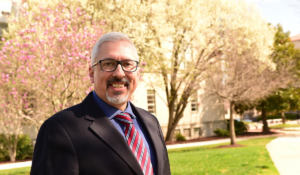
Photo by Patrick D. Lewis/The Tower
By Patrick D. Lewis
Several professors at Catholic University hosted a “teach-in”on Tuesday in the Pryzbala University Center to discuss their opposition to the US war in Iran.
The event included participation from Politics Department Chair Maryann Love, theology professor and peace and justice program co-director Bill Barbieri, history professor Lev Weitz, and several experts from other organizations. It was sponsored by the Department of Global Studies, Peace and Justice Studies Program, Politics Department, and McLean Center for the Study of Cultures and Values.
In opening remarks, Barbieri called the program an “extended educational event” intended to “illuminate the complexity of and provide insights into important issues of the day.” He said the Peace and Justice Studies Program has held teach-ins several times over its decades-long history, including during the wars in Iraq, Syria, and elsewhere.
Barbieri said he wanted to help students in “meeting your civic duty to inform themselves and think critically about the use of coercion and acts of violence that are currently being committed in their name [by the U.S. Government].” He stated he had been “struck…by an astounding series of violations of established norms surrounding war, especially by American leaders.” He said he could count at least ten violations of the “international rules of war,” including the targeting of civilians, and argued that “no persuasive case was made that Iran constituted a viable military threat to the U.S.”
Weitz discussed the history of U.S.-Iran relations, and the experts on the panel discussed a range of topics, including the case for war the Trump administration has made, how the war might end, and implications of the conflict on the broader situation in the Middle East.
Kelsey Davenport, with the Arms Control Association, said that “there’s no military solution to the Iranian nuclear issue…no matter who is in power in Iran…there is going to be a proliferation risk.” She said that diplomacy is the only way to manage the Iranian nuclear threat and that Iranian leadership will likely only have a greater desire to develop nuclear weapons as a result of the U.S. strikes on their country.
Edward Alam, a professor at Notre Dame University in Lebanon, spoke about the situation in Lebanon, which includes over 1,000 deaths in the country as Israeli forces trade strikes with terror groups in Lebanon. He said Israel plans to occupy around 14% of Lebanon in a planned ground campaign on the south of the country that will target Hezbollah, a powerful Iran-backed terrorist group. He said Lebanon continues to be in an uncertain political situation, which he attributed to Israeli and American “attempts to control our region.”
The next speaker, Adam Weinstein of the Quincy Institute, discussed the implications of the war on the Middle East. He said that many Washington politicians have long claimed to have plans to solve issues in the Middle East, but that those plans have rarely worked out and have never lasted for any significant length of time. He said, “we should not be assassinating leaders and trying to topple regimes” when the U.S. doesn’t know what the effects down the road might be. He also said that many Iranian leaders today remember their involvement in the Iraq war twenty years ago, which likely hardens their resolve to oppose U.S. activities in Iran today, and said that the United Arab Emirates, previously seen as a safe place within the region, is no longer considered that, which will destabilize the country and other wealthy smaller nations on the Gulf.
Love, the final speaker of the event, said U.S. interventions in the Middle East are often “detached from reality” and do not achieve their aims of building a lasting peace. She also said the Trump administration has not had a well-formed goal for the end of the war and that the operations in Iran “[have] not been meeting just war criteria.” She said the war is not considered a just war under Catholic doctrine and that she thinks the war will lead to greater terrorism around the world. She said she considers the U.S. killing of many Iranian leaders to be murder. “You cannot skip to the end and believe that, simply by the destruction, you will achieve” war aims, she said.