Catholic University Event Explores History of World Cup
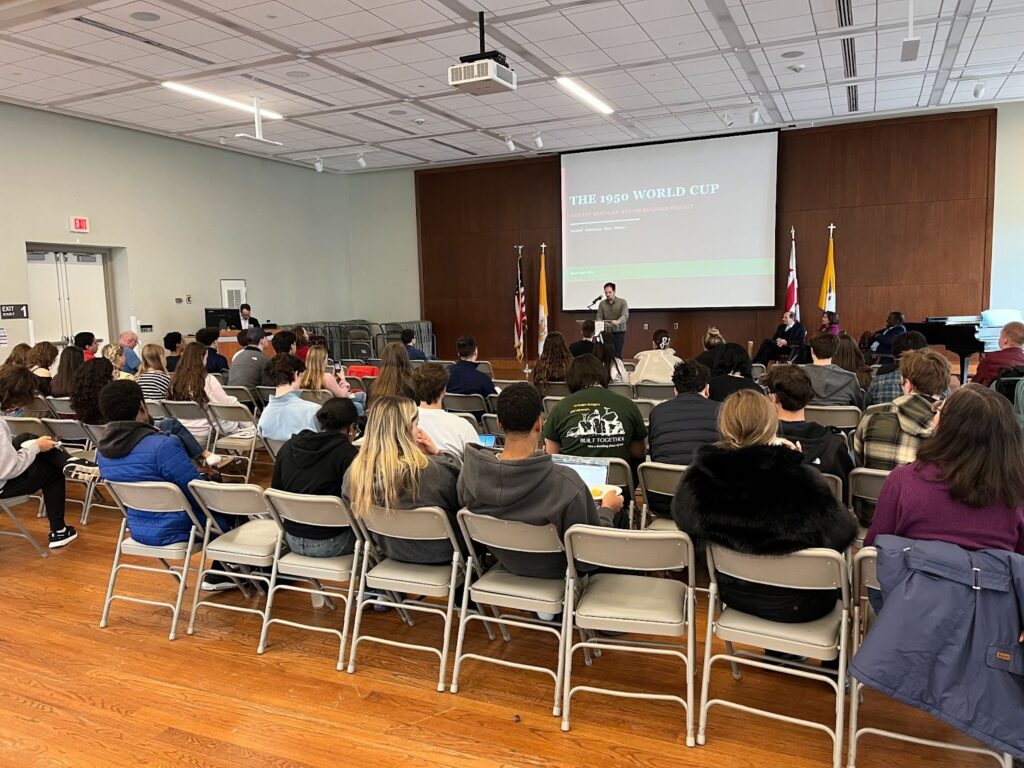
Image courtesy of Patrick D. Lewis/The Tower
By Patrick D. Lewis
An event hosted by the Department of History and Anthropology and the Department of Global Studies last Wednesday brought together several speakers to tell stories about moments in the history of the World Cup ahead of the North America-hosted edition this June.
Four experts spoke at the event, who brought a variety of cultural perspectives to the event. The first speaker was Dr. Luiz Burlamaqui of The George Washington University, who discussed Brazil’s role in the World Cup. Burlamaqui said that Brazil and South American countries actually benefited from the problems FIFA encountered during World War II because their contributions kept the organization financially solvent during a time when most of Europe was not interested in or could not think about soccer and sustaining the organization. Brazil has participated in several World Cups since that time and is now recognized as one of the mainstays of the soccer world.
That recognition has not come without bumps in the road, though. In the 1950s, Brazil hosted the World Cup and saw a low participation count because Germany was banned in the aftermath of the war, and several other European countries decided Brazil was too far to travel to.
Dr. Chuka Onwumechili of Howard University talked about the Nigerian history of soccer and the World Cup and his personal experiences with the event. Nigeria has long loved soccer and has produced some of the best-known players in the world, but, along with all of Africa, was for a long time discriminated against by the European-controlled FIFA. At the time, when only 16 countries made the World Cup bracket, all but two slots were reserved for European and American countries. That left one slot for the Middle East, one for Africa, and Asia. Nigeria and the rest of Africa boycotted the 1966 World Cup and later received a guaranteed slot.
Onwumechili said that he attended the 1994 World Cup in America. He said he traveled to Los Angeles to receive tickets to the game and was concerned when he discovered that the last country’s representatives to pick up tickets had brought an armored car, so sought after were the tickets. Onwumechili had only a briefcase but made it home safely.
Dr. Arpad von Klimo of the Catholic University History Department discussed the history of German soccer, specifically West German teams during the Cold War. He said that West Germany was truly a different country than Germany prior to World War Two and the reunified Germany after the end of the Cold War. The German teams during the Cold War were some of the most successful teams in history, making the final six times and winning it three of those times, something reunified Germany teams have been unable to match.
Finally, Dr. Niki Akhaven of the CUA Media and Communications program discussed the history of Iran and the World Cup. Iran has long been a soccer-loving country, but has often seen its performance on the field be overshadowed by political issues involving its country. At times, matches between the U.S. and Iran have showcased unity, with much-staged handshakes, friendly exchanges, and other shows of shared values. At other times, though, those displays of unity have been more genuine and extemporaneous, such as the time the U.S. defeated Iran and an American player hugged a crying Iranian player.
Now, with the World Cup coming to the U.S. again during a time of war between the two countries, Akhaven said unity is far from most minds. President Donald Trump has said that he cannot guarantee the safety of the Iranian team, but an Iranian request to FIFA to be allowed to play their matches in Mexico was denied.