Daredevil: Born Again Resurrects the Character with Heart and Clear Ambition
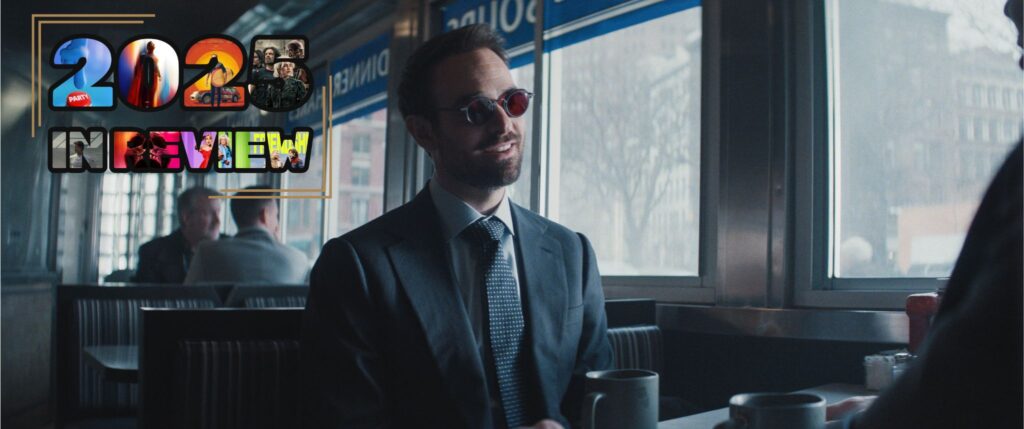
Image courtesy of Marvel Television
By Luis Zonenberg
When looking back on many of the TV shows released last year, there were a good number that had a growing apprehension from audiences. None probably drew as much concern, though, as Daredevil: Born Again. The entire series was overhauled for extensive reshoots, even going so far as to bring in a new showrunner to spearhead it in a new direction. This certainly ruffled a few feathers in the Marvel discourse, and I wanted to look back on its first season to see if it still holds up.
The series picks up a year after Matt Murdock (Charlie Cox) hung up his cowl after failing to prevent the loss of his best friend, Foggy Nelson (Elden Henson). Murdock now formed a new law firm with District Attorney Kirsten McDuffie (Nikki M. James) after falling out with his ex-girlfriend, Karen Page (Deborah Ann Woll). Trouble begins to brew when a dangerous criminal called Muse (Hunter Doohan) runs rampant through New York City, making graffiti with the blood of his victims!
Things only get worse when mob boss Wilson Fisk (Vincent D’Onofrio) reemerges to run for mayor of the city. Fisk attempts to gain a stronghold of the city, establishing an Anti-Vigilante Task Force (AVTF) to crack down on the growing number of vigilantes in the city. The tension only escalates when Bullseye (Wilson Bethel) breaks out of prison with plans to assassinate Fisk. Murdock must now don the cowl once more in hopes of confronting Fisk while getting revenge on Bullseye in the process.
I covered the first two episodes in a separate review, but never had time to explain my thoughts on the rest of the season. Looking back on it now, it’s clear the filmmakers are trying to stitch two separate narratives into a cohesive story. While the cracks are more apparent, I will admit that it is impressive how well structured this first season was, given its turbulent production woes. It does have an odd pacing, but it moves steadily with a clear direction of where it’s ultimately heading.
Meandering at certain points, the show drags out story threads that easily could have been consolidated with proper care. The second and third episodes easily could have been trimmed down to a single bottle episode, with the only other fatty part of the steak being the sixth episode, “Excessive Force.” These were clearly a product of the filmmakers retooling the original story lines, but thankfully, these did not make up the majority of the season.
The first episode, “Heaven’s Half Hour,” did a wonderful job of reintroducing the character while grounding him in a harsh reality he inevitably has to confront. The last two episodes, though, were easily the best ones of the whole season, showing the clear prerogative of showrunner Dario Scardapane. He masterfully brings the series back to its roots here, reuniting many of the original characters while teasing what’s in store next season, even if it seems maybe a little too familiar for some audiences.
Directors Justin Benson and Aaron Moorehead did an exceptional job and should be praised for taking on such an arduous endeavour. The directing duo managed to weave a distinct style that complements the rustic nature of the original series while making it feel right at home in the wider MCU. This style proved to be most compelling in the bottle episode, “With Interest,” cleverly combining the new tone with the abandoned storyline in a way that was as sharply directed as it was written!
The cast does a bang-up job up here, with Charlie Cox proving once more to be a charming and compelling lead. He retains all the core components of his character while making him feel more jaded, slipping back into his character with ease. Vincent D’Onofrio is just as excellent to watch here, offering a more subdued performance that cleverly hides the anger that continually builds up over the course of the season. Other supporting actors like Ayulet Zurer, Michael Gandolfini, and John Bernthal help anchor the series with their respective roles.
The cinematography was mesmerizing, employing a combination of depth control and various aspect ratios to visualize how Murdock perceives his environment. The photography brilliantly showcased the wide landscapes of the city while honing in on the season’s intimate moments. It beautifully complemented the visual style of the series while enthralling audiences into the action as well as the surrounding environment!
The VFX often worked seamlessly with the practical sets during action-packed scenes. There were times, though, when the CGI backgrounds or animated stunt-doubles were more noticeable, trying their best to complement the visual aesthetic of the show. These moments were not too distracting, with the gorgeous sets and beautifully choreographed stunt-pieces immersing you so much in the action that you hardly have time to breathe.
The show marks an audacious return for the character, signaling a clear departure from Marvel’s usual formula. As of right now, it’s hard to tell what will come, with it seemingly pitting Daredevil and Kingpin again in a way too reminiscent of the original show’s first season. Whether that’s the case or not, there’s no denying the mad talent present both behind and in front of the camera here. With Charlie Cox slipping comfortably back into character, Daredevil: Born Again resurrects the titular character in style with clear ambition from showrunner Dario Scardapane.
Daredevil: Born Again is now streaming on Disney+.
Rating: ★★★ ½ of five