Ghosts: The Play About Idealization and Truth
Screenshot
Image Courtesy of Jayden Parsons
By: Abby Marinari
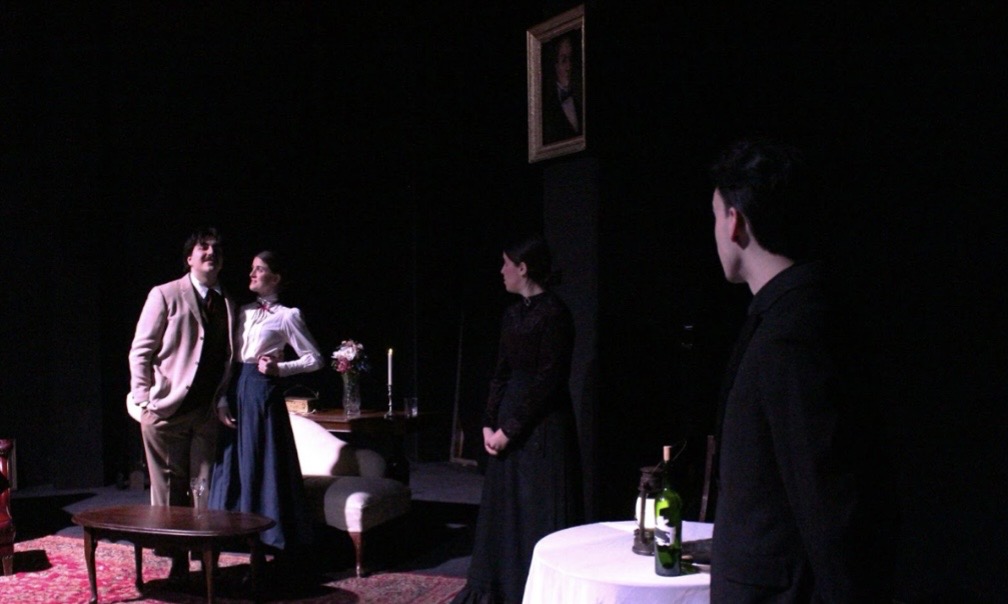
Have you ever wondered what a play about legacy and ideals would look like? Perhaps one about insanity and trauma? Then, Ghosts by Henrik Ibsen is a good start. This drama, which was completely directed and managed by senior Drama major, Jayden Parsons, premiered in the Hartke Theatre Lab, playing from February 13th to 15th. Set in 1881, Ghosts tells the story of Mrs. Helen Alving (Grace Stephens) dealing with secrets and trauma, all while managing an orphanage with the local Pastor Manders (Daniel Zanchettin) following the death of her husband. In addition, it follows the life of her son, Oswald (Mateo Sur), as he returns home after about 20 years, and much has changed with both him and the estate.
If you were able to see the show, you would have immediately been struck by the theme of “ideals versus truth”. This message was precisely why Jayden picked this play a year and a half ago. She says, “In our current time with social media running rampant, we allow society to show us how we should live our lives and what is considered a ‘good’ life. While we are no longer in 1881, I cannot help but see these connections with how social media and the news runs our lives”. With this constant questioning of reality and bias, it is difficult to examine how humanity experiences and views life. Are we the product of how we were raised or how we were born? Ghosts quite brazenly investigates this debate of nature vs. nurture, with the addition of trauma.
While everyone experiences trauma differently, not many can say they were forced into an arranged marriage, lived with a cheating husband, and were pushed to live their life in such a deplorable way as Mrs. Alving had. Jayden hoped the audience would understand that many people cope with trauma differently, and to ask the audience to give her some sympathy. This play is important in understanding Jayden’s message of awareness about trauma; she elaborates, “It will be present in our society forever, and I feel as though we put it on the back burner when it comes to mental health.”
From a directing standpoint, Jayden had a fascinating idea for handling this divide between an idealist world and a realistic one, literally dividing the space in half! Pastor Manders is a character who is caught up in the hypotheticals, so he stays primarily on stage left. Meanwhile, Mrs. Alving, the only character to consistently be in the know throughout the show, is mainly focused on stage right. That is, until she is trying to convince her son, Oswald, to let go of the truth about his father, she crosses onto the other side out of desperation. This physical divide is extremely subtle in its reason, it clearly creates a sense of opposition and tension throughout the play. With such a clear principle in place, there was so much opportunity for the actors to balance out the space in a way that seemed natural and meaningful.
Despite this really clear direction and messages, many audiences struggled to understand the specific text of the play, partly due to the fact that Ghosts was written in 1881 and is translated from Dano-Norwegian to Old English. In order to help clarify some of the nuances of the play, senior acting major Grace Stephens and sophomore acting major Mateo Sur explain a little more about the inner workings of their characters.
For Grace, Mrs. Alving thinks of herself as more of a progressive woman (at least for the 19th century) who is simply doing her best with the hand she’s been dealt. In studying her character, Grace specifically noticed, “You realize all the standards women are being held to; protecting her son’s physical and mental health, keeping up a good image of her family, and especially her husband. Would you make the same sacrifices?”
Grace’s interpretation truly reminded audiences of the power that lies in compassion. It is important for an actor not to judge their character, but to also make that point poignant, and it was simply beautiful to watch. Similarly, Grace enjoyed playing a character who was not completely steadfast in one way of life, but rather many different, contrasting ones. The commentary on which is the “right” way to live was intriguing, and she was honored to be a part of such a project. A “dream come true” that could not have a better way to close out her time at CUA.
When Oswald’s character is first introduced, many would think the character to be charming and easygoing throughout the entirety of the play. In reality, Oswald becomes increasingly more emotionally unstable and even more sick with the unspoken disease, syphilis. As the play progresses, it is discovered that Oswald believed he gave it to himself, when in actuality, it was passed down from his father, whom he greatly idolized. The duality of Oswald is another example of contrast in the show, but in this case, it is determining where the charming, people’s man is talking, or the diseased-ridden man.
Towards the beginning of the show, Oswald is proud that he has his father’s name, but desires to live a fulfilled life beyond that; therefore, making it even more crushing when he is punished because of his father’s sins. For Mateo, portraying a role that is so unsteady cannot have been easy, yet the constant mood swings were jarring but never awkward and were just as purposeful as the charismatic, relaxed moments. His opinion of Oswald parallels Grace’s opinion about Mrs. Alving. It is important to realize Oswald is a victim.
Sur says, “I think I want the audience to see that Oswald himself is not a bad person. It’s just…he kind of lost his mind with the disease. If it were not for the disease, he would’ve been the good guy.” There is, once again, a focus on trying to have empathy for people that is otherwise easy to judge. Empathy is a beautiful thing, and while it is not referenced in the show, it is certainly something that is necessary to appreciate this play.