Saint of the Week: Pope John Paul II
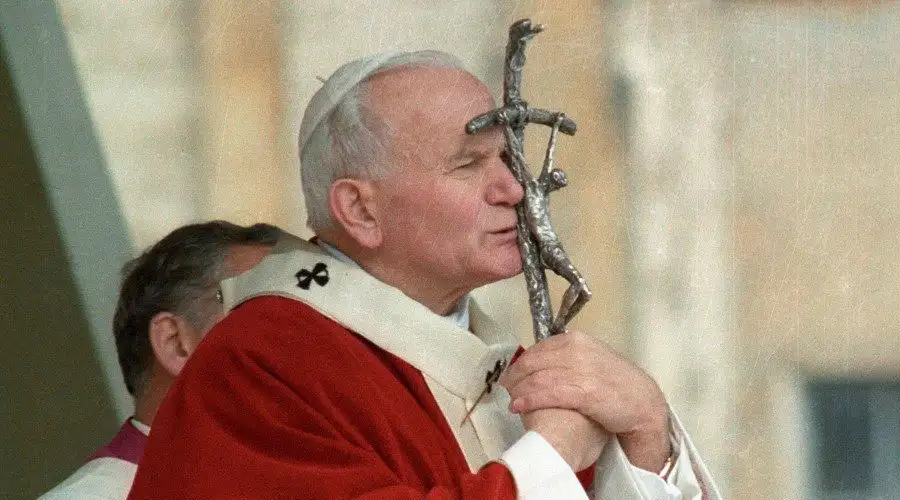
Image courtesy of EWTN.
By Paul Manetto
A playwright, philosopher, and poet who traveled around the world… sounds like the description of some eccentric character from out of a soppy romance novel. However, all of these things come together to form one of the most well-known saints of the millennium: John Paul the Second. His early life was one of intense misfortune, losing both his parents early in life, surviving under the Nazi occupation of Poland, only to be liberated by the atheistic communists of the Soviet Union. Yet his later years would be ones that changed the Catholic Church forever, ushering in a new era of theology, canonizing 482 saints, and becoming the most seen person in human history.
John Paul, born Karol Wojtyla on May 18, 1920, had it rough in his childhood. His family had already lost his sister Olga as a baby; they would then lose his mother, and finally his brother would die as a doctor treating the scarlet fever epidemic. This left just Karol and his dad, whom he would credit with teaching him how to live life as a virtuous Catholic. He attended college in Krakow, where he became an active participant and writer of plays at the local theatre.
However, if you know anything about 1940s Poland, you know some uninvited guests were going to come and make life a living hell for the Polish people, whom the Nazi’s considered inferior. Not only was Karol forced into labor under the Nazis (hauling stones in a quarry), but his dad also died in 1941. Oh, and he also got hit by a truck in 1944 (just to show you how bad his life was).
Thankfully, though, the Nazi regime would fall in 1945 and be replaced by a period of peace and prosperity in which the Polish people were free to govern themselves. Just kidding, the Soviets transformed the Nazi’s fascist dystopia into a Soviet communist dystopia. The officially atheistic state cracked down hard on organized religion, but Karol, both as a priest and later a bishop, made it his mission to encourage Soviet resistance and keep the faith alive in Poland.
He was elected as pope during the 1978 Conclave, taking the name John Paul the Second. Here he would remain until his death in 2005, the second longest papacy in Church History. One of the most incredible stories during his time as Pope came in 1981, when a gunman shot John Paul at close range in St. Peter’s Square. The bullet came mere millimeters from ending the new pope’s life, but, according to John Paul, was curved away by the Virgin Mary, whom he claimed to have seen just as the bullet hit him. The assassination attempt occurred on May 13, a key date, as it was the anniversary of Our Lady of Fatima, whose visions are believed to have shown an assassination attempt on the pope.
Other than getting shot at, John Paul worked with leaders across the Western world, including U.S. President Ronald Reagan, to help orchestrate the downfall of communism and support the Solidarity movement in Poland. He also wrote his famous works regarding the Theology of the Body, a response to the radical sexual revolution of the 1960s and 70s. His work with the youth of the Church added to his legacy, beginning the Church’s tradition of holding Youth Day in locations across the world.
If you want to learn more about John Paul II, the best way to do so is to visit the JP2 Memorial Shrine, across the street from O’Boyle Hall. This museum houses artifacts from across John Paul’s life, including his skis, papal garments, and gifts given by heads of state. John Paul the Second is one of, if not the most famous, saints of the new millennium, and his legacy lives on proudly in the Catholic Church around the world.